Different Types Of Attacks

Introduction to Types of Attacks
The phrase "types of attack" describes the methods that malicious actors use to break into networks, digital systems, or individual users, leading to data breaches, illegal access, or system disruption. In the constantly evolving realm of cybersecurity, understanding the variety of attack types is crucial to developing effective protection strategies. Phishing, ransomware, denial-of-service (DoS) attacks, and malware such as viruses, worms, and trojan horses are examples of cyberattacks. Criminal activities including robbery, vandalism, and psychological manipulation of others are examples of physical assaults.
Insider
assaults use internal resources to the advantage of hostile insiders or
inadvertent vulnerabilities. While application attacks focus on exploiting
software defects, network attacks look for holes in the network architecture.
Attacks using social engineering deceive victims into divulging personal
information.
Wireless attacks exploit vulnerabilities in wireless networks. Understanding different attack types helps people and companies strengthen security protocols, lower risks, and safeguard digital assets in an increasingly connected world.

Table of content
Ø Introduction
Ø Different type of attacks
- Web application attacks
- Network-based attacks
- Malware- based attacks
- Social engineering attacks
- Physical attacks
- Insider attacks
- IOT-based attacks
- Password attacks
Ø How to Prevent attacks
Ø Conclusion
Different type of attacks
1.Web application attacks
Cyberthreats known as
online application attacks utilize vulnerabilities in online applications as
points of entry to steal user information, gain unauthorized access, or disrupt
the usual functioning of the application. Because web apps are accessible through
web browsers and sometimes provide dynamic content, they are attractive targets
for attackers. The following lists a number of common assaults on online
applications.
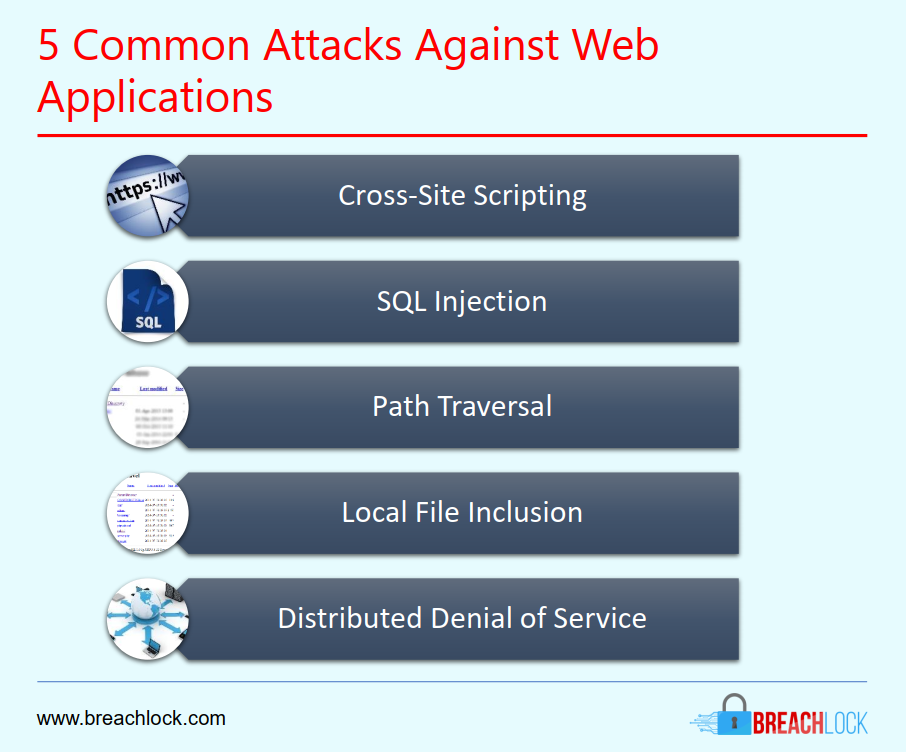
cross-site scripting (XSS) is the term for when an attacker inserts malicious scripts into web sites that are viewed by other users. Cookies, session tokens, and other private information are accessible to the attacker when the malicious script is executed using the victim's browser context. Via XSS attacks, users may be redirected to malicious websites or web pages may be altered.
Ø SQL Injection
Using an application's input fields as a means of attack, SQL Injection (SQLi) introduces malicious SQL code into the backend database query. If the web application does not sufficiently check and sanitize user inputs, the injected SQL code could execute undesired database instructions, potentially granting the attacker access to sensitive data or enabling them to change, destroy, or steal data.
Ø Session Hijacking
During session hijacking, sometimes referred to as session stealing or session sidejacking, an attacker steals or intercepts a user's session identifier in order to obtain unauthorized access to their account. Attackers can accomplish this by listening in on unencrypted network connections or taking advantage of flaws in the online application's session management system. After taking over the session, the attacker can pretend to be the victim and act on their behalf.
Ø Remote code Execution
A hacker can execute arbitrary code on the web server using a severe online application vulnerability called remote code execution (RCE). RCE occurs when an application allows malicious code injection, such as operating system commands or scripts, and fails to sufficiently verify user inputs. If the vulnerability is successful, the attacker may be able to fully take control of the web server and hosting environment.
2. Network-based attacks
Network-based assaults,
also referred to as cybersecurity threats, take advantage of weaknesses in
computer networks to disrupt operations, compromise data, or gain illegal
access. These attacks target different parts of the network infrastructure in
order to accomplish their damaging objectives. Here are some descriptions of
common network-based attacks

- ARP spoofing
ARP (Address Resolution Protocol) spoofing, also called ARP poisoning, is an attack where the attacker uses fake ARP packets to connect their MAC address to the IP address of a reliable network device. The lawful device's network traffic can be intercepted or altered by the attacker to facilitate a man-in-the-middle attack. Data interception, session hijacking, and other network-based attacks are made possible by ARP spoofing.
- Port Scanning
Attackers can find open ports and services on a target system or network by using the port scanning technique. A port scan can help the attacker identify possible points of entry for exploitation. The attacker could try to get access without authorization, launch more attacks, or take use of known flaws in the services that are running on the designated vulnerable ports.
- Packet Sniffing
Capturing and analyzing data packets sent over a network is known as packet sniffing, often called packet interception or network sniffing. Attackers can intercept unencrypted network traffic using packet sniffing tools to obtain sensitive data, such as usernames, passwords, or confidential information. This attack may be more dangerous when sensitive data is delivered in clear text.
- Man-in-the-Middle(MitM) attack
Man-in-the-Middle (MitM) attacks
occur when an attacker surreptitiously intercepts and relays communications
between two parties. Transmitted messages between the parties are
surreptitiously relayed, altered, or blocked by the attacker. Because of this, the
attacker might be able to listen in on talks, obtain login credentials, or
intercept private information.
3.Malware- based attacks
Malicious software, sometimes known as malware, is any software designed to do harm to a user, network, or computer system. Malicious software is distributed and run on the target system in malware-based attacks in order to steal data, disrupt operations, or obtain illegal access. The list of several malware-based attacks is as follows:

Ø Virus:
Malware that attaches itself to a reliable program or file and multiplies by infecting additional files or programs on the same system is called a virus. When the malicious software is used, the virus becomes active and replicates itself in order to spread further. Viruses can be designed to perform a wide range of malicious functions, including erasing files, distorting data, and interfering with a computer system's ability to function.
Ø Worm:
Malware that spreads by itself without the need of a host file is called a worm. It uses security holes in computer networks to propagate itself and infect other systems without the help of humans. Because of their fast pace of network transmission, worms seriously damage targeted systems and use network capacity. Certain worms are designed to carry payloads that perform harmful tasks, such as erasing data or granting illegal access.
Ø Trojan:
A Trojan, often known as a Trojan horse, is a cunning kind of malware that trick people into installing it by pretending to be reliable files or programs. After it is installed, the Trojan might open a backdoor for the attacker, allowing them to get illegal access to the compromised system. Trojan horses can be employed for a variety of purposes, such as espionage, software distribution, and data theft.
Ø Ransomware:
Ransomware encrypts the victim's data and then requests payment to unlock the decryption key. Ransomware is a type of malware. The user's files are rendered inaccessible until the ransom is paid when ransomware affects a system. Attacks using ransomware have the potential to cause enormous harm, including data loss, disruptions to business, and financial losses for both people and companies.
Ø Spyware:
Spyware
is a category of software designed to secretly collect information about a
user's activities without the user's knowledge or consent. It has the ability
to trace browsing patterns, capture keystrokes, track sensitive data, and
gather passwords. After the data has been collected, the attacker usually
obtains it and can use it for a variety of purposes, such as targeted
advertising, identity theft, or data sales on the dark web.
4.Social engineering attacks
Cybercriminals employ social engineering assaults as a strategy to coerce victims into disclosing private information, carrying out particular tasks, or allowing unauthorized access to networks or computer systems. Rather than concentrating on technological weaknesses, social engineering takes advantage of human nature, depending on psychological trickery and manipulation to accomplish its goals. The explanations of several social engineering assault methods are provided here.

Ø Phishing:
Phishing
is one of the most common social engineering scams. Phishing attacks involve
the use of bogus emails, texts, or websites that purport to be reliable
companies or organizations. Usually, the messages trick the receivers into
opening malicious links, downloading malware, or sending sensitive information
like credit card numbers, login passwords, or personal data.
Ø Spear Phishing:
Spear phishing is a specific form of phishing that
targets an individual, company, or group of individuals. The attackers gather
the target's details, like name, position, interests, and contacts, to craft
highly tailored and compelling communications. The chances of success are
increased by this method since the communications appear more relevant and
genuine to the recipients.
Ø Baiting:
Baiting
is the process of getting someone to do something by offering an enticing
reward, like a tangible USB drive, software update, or free download. The
attacker obtains unauthorized access to the system or compromises the user's
security when the victim takes the bait and proceeds with the action. There's
even a chance that the bait contains malware.
Ø Pretexting:
The creation of a fictitious situation or pretext to persuade someone to reveal personal information is known as pretexting. The attacker adopts a false identity or position, like that of a coworker or customer service representative, in order to gain the trust of the target. After that, they coerce the victim into disclosing private information or taking actions against their better judgment.
Ø Tailgating:
Tailgating,
sometimes referred to as "piggybacking," is the practice of an
uninvited individual physically entering a prohibited location by closely
following a person who is authorized. For example, a potential attacker could
pose as friendly and accompany a staff member with access to a protected
location in order to gain entry by taking advantage of their trust.
5.Physical attacks
Physical attacks are cybersecurity risks that take advantage of weaknesses in the real world to obtain information without permission, steal confidential data, or compromise security. Rather than taking advantage of software or network vulnerabilities, these attacks target individuals, things, or environmental weaknesses. The following lists the common physical attack methods.
v Dumpster Diving
Dumpster diving is the practice of searching through trash or other abandoned items for personal information. In order to obtain information they can utilize, such as login credentials, financial information, or proprietary materials, attackers may search through destroyed electronic devices, documents, or receipts. Dumpster diving can be especially risky for businesses that neglect to properly dispose of sensitive information and destroy papers before discarding them.
v Hardware
Keyloggers
Place hardware keyloggers
in the gap between the computer and the keyboard. All keyboard inputs,
passwords, credit card numbers, and other private information are monitored by
them. Hardware keyloggers are a serious security risk in environments where there
are lax physical access controls over computers because of their covert
installation and difficult to detect.
6.Insider attacks
Cybersecurity risks that
originate from within a company's ranks are called insider attacks. Attackers
who abuse their authority to get legitimate access to an organization's
facilities, data, or systems are typically partners in business, contractors,
or employees. Insider attacks are dangerous to an organization's security
because they often take advantage of access and trust levels that are not
available to external attackers. They can be intentional or unintentional. The
descriptions of common forms of insider attacks are as follows:
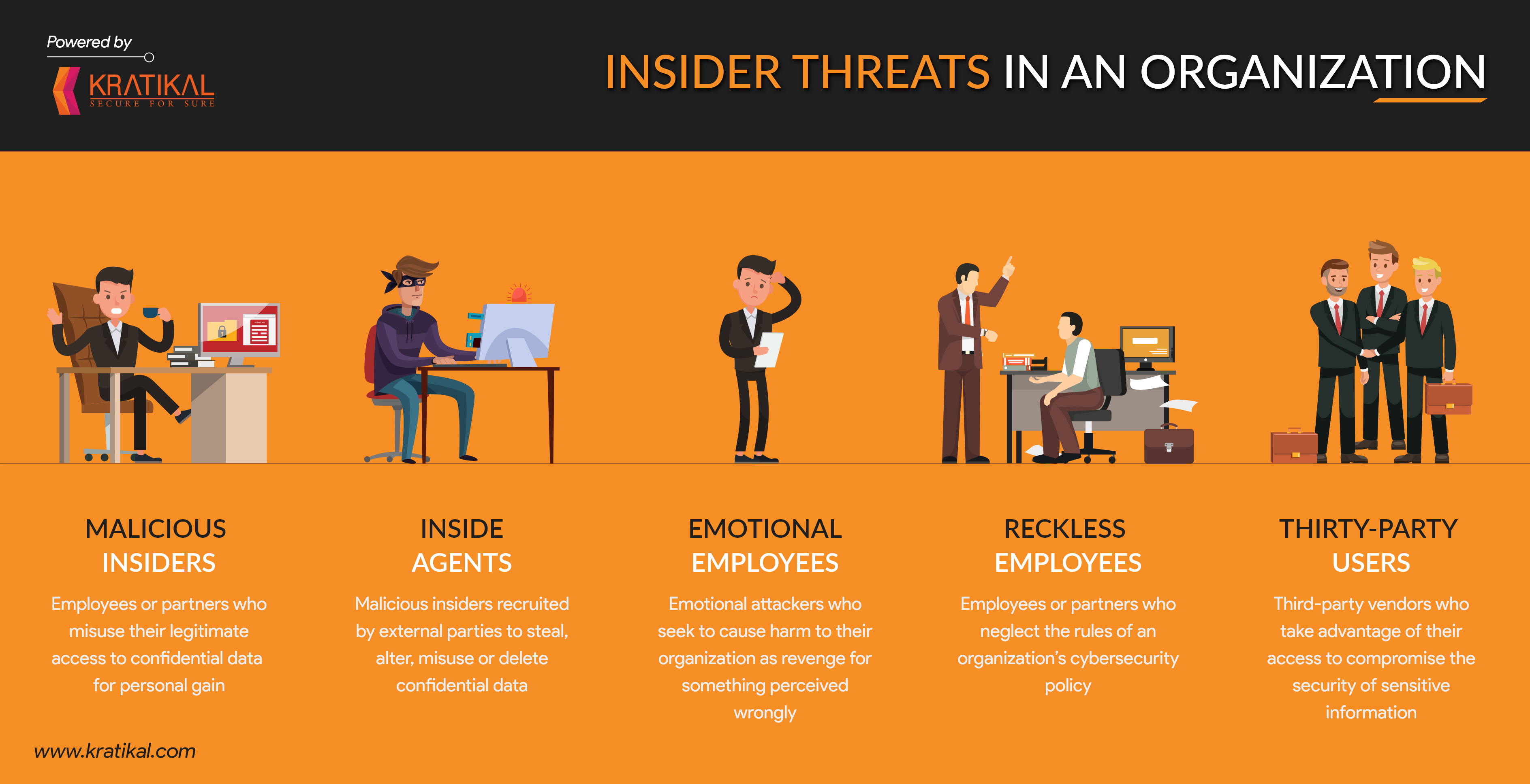
o Data Theft
Insiders have the ability to either profit by selling proprietary or sensitive knowledge to competitors or other parties, or they can steal it from a corporation. Insiders may obtain unauthorized access to confidential or trade secret information, financial data, or consumer details. Data theft can result in monetary losses, damage to the company's brand, and legal implications.
o
Insider Threats:
Insider threats are people who deliberately act maliciously to jeopardize the assets, reputation, or security of a company. These could be greed-driven individuals, resentful former coworkers out for blood, or insiders who have been threatened or blackmailed by other parties. Insider threats may result in sabotage, intellectual property theft, data breaches, or the spread of misleading information.
o
Sabotage
Insiders who engage in sabotage aim
to deliberately interfere with an organization's operations or damage its
infrastructure. To do this, you might have to erase all of your data, take down
important systems, introduce malicious code into the network, or tamper with
procedures to cause chaos. Insider sabotage has the potential to harm a
company's reputation in addition to causing significant disruption and
financial losses.
7.IoT-based
attacks
Cyberthreats known as
IoT-based attacks specifically target devices connected to the Internet of
Things. IoT gadgets are becoming everyday objects because they contain
software, connection, and built-in sensors that collect and share data online.
These attacks leverage vulnerabilities in IoT devices to gain control over
them, disrupt their functionality, or use them as weapons in other attacks.
Several common Internet of Things (IoT) attack tactics are described below:

- Botnet Attacks
IoT
devices are infected with malware during a botnet assault, allowing remote
command-and-control (C&C) server control over the devices. The compromised
computers, often known as bots or zombies, can cooperate to carry out a number
of destructive operations, including crypto-jacking, distributed denial of
service (DDoS) attacks, and spamming. Botnets are especially hazardous because
they may launch coordinated, massive attacks by pooling the processing power of
multiple compromised machines.
- Attacks
on Firmware:
Attacks
on firmware are directed on embedded software, also known as firmware. Firmware
vulnerabilities could be used by attackers to gain control of the device or
change its functionality. By hacking into the firmware, an attacker can take
control of a device, alter its functionality, or render it inoperable. Firmware
upgrades are rarely applied by users, so these attacks might linger for a
while.
- Command Injection
A
command injection attack uses input from an IoT device to execute unauthorized
commands or code on the underlying system. Hackers have the ability to take
control of IoT devices arbitrarily and compromise their security by inserting
malicious code into web forms, APIs, or other user interfaces. Command
injection vulnerabilities could lead to remote code execution, unauthorized
data access, or even complete control of the Internet of Things device.
8.Password attacks
Attackers utilize password attacks as one of their tactics to gain unauthorized access to user accounts or systems by taking advantage of weak or hacked passwords. These attacks attempt to circumvent authentication procedures by figuring out or decrypting passwords. Details on several password attack methods are provided below.
- Brute Force Attack
A
brute force attack involves the attacker repeatedly trying every possible
character combination in an effort to guess the correct password. This method
can be used to break too-simple or short passwords, but it takes a lot of
effort and resources. Brute-force attacks entail the use of automated or manual
techniques to quickly try different password combinations.
- Dictionary Attack
A
dictionary attack uses a pre-selected set of words, phrases, or passwords from
a "dictionary" in an attempt to get authentication. Every word on the
list is used by the attacker as the password for the intended account. Because
dictionary attacks concentrate on passwords that a large number of users are
likely to use, they perform better than brute force attacks.
- Rainbow Table Attack
Rainbow
table attacks are a specific kind of password cracking that use pre-calculated
tables with password hashes and their corresponding plaintext passwords. The
attacker can quickly use these tables to find for the password linked to a
certain hash. To prevent this attack, which significantly lowers the efficacy
of precomputed tables by adding random data to each password before hashing,
systems frequently employ cryptographic salts.
- Credential Stuffing
Using
previously published login and password combinations from one website or
security breaches, this attack tactic seeks to obtain illegal access to other
websites. Because a lot of individuals use the same passwords across many
websites, attackers utilize automated tools to check popular username/password
combinations across multiple platforms in order to get access to additional
accounts.
How to Prevent Attacks?
To stop attacks, a proactive, multi-layered cybersecurity strategy is required. The following are vital steps you can take to defend yourself or your company from different types of attacks:
- Maintain Software and Systems:
Update your operating system, apps, and
security patches on a regular basis. You can lessen the likelihood of attacks
that exploit known vulnerabilities by keeping up to date.
- Use
Strong and Unique Passwords:
Regularly update your programs, operating
system, and security fixes. By staying current, you can reduce the chance of
attacks that take use of known vulnerabilities.
- Enable Multi-Factor Authentication (MFA):
When it's feasible, turn on multi-factor authentication (MFA). MFA increases security by requiring users to provide other authentication factors—like a one-time code sent to their phone—in addition to their password.
- Educate Users on Security Awareness:
Regular
security training and awareness programs that educate users about attack
methods like phishing and social engineering should make users aware of
security dangers. Teach children to spot and report questionable behavior.
How Could Cyber attacks affect us
Conclusion
There
are many different kinds of attacks, which poses significant challenges for
cybersecurity. Comprehensive security systems against ransomware, phishing,
malware, and physical and social engineering attacks are obviously necessary.
By being aware of different attack vectors, people and organizations may
improve their security strategy, put preventative measures in place, and stay
alert against ever-evolving dangers. By encouraging cooperation, exchanging
knowledge, and keeping up with new threats, we can strengthen our ability to
safeguard digital assets and guarantee a safer and more resilient cyber
environment.
FAQs
1.How can I safeguard against insider
threats?
Answer: To lessen the threat posed by insiders, organizations may implement strict access controls, employee activity monitoring, background checks, and staff education.
2.How do wireless attacks exploit
vulnerabilities?
Answer: Wireless attacks exploit vulnerabilities in wireless networks, such as the capacity to listen in on wireless communications or use untrusted access points
Reference
https://www.simplilearn.com/tutorials/cyber-security-tutorial/types-of-cyber-attacks
https://www.rapid7.com/fundamentals/types-of-attacks/
https://www.educba.com/types-of-attack/
https://www.vu.edu.au/about-vu/news-events/study-space/5-easy-ways-to-protect-yourself-from-cyber-attacks
Comments
Post a Comment